Are chatbot promises legally binding on your business?
The question isn't how clever your chat agent sounds. It's what it's allowed to say at 11:40pm when nobody is watching.
Say you run a flooring showroom in Scottsdale. The chat agent on your site has earned its keep: it handles the engineered oak questions, books measure appointments, and caught four jobs last month that would have hit voicemail. Then at 11:40pm somebody asks whether you price match the warehouse store across town. The agent says yes. It offers ten percent on top.
You find out nine days later, when somebody arrives at the counter with a screenshot.
Chatbot promises are legally binding often enough that you should plan as though they always are. A tribunal has already made an airline honour a refund policy its chatbot invented, treating the chat window as one of the ways the company speaks to customers. The fix isn't a cleverer model: it's a written list of what your agent may state, with numbers behind a lookup and everything else routed to a person.
Are chatbot promises legally binding?
Sometimes, and you should plan as though the answer is always yes.
The case everyone cites is Moffatt v. Air Canada, decided by British Columbia's Civil Resolution Tribunal in February 2024. A customer asked the airline's chatbot about bereavement fares, was told he could book now and claim the discount back within 90 days, did exactly that, and was refused. The tribunal found the airline liable for negligent misrepresentation and ordered it to pay the fare difference, around 650 Canadian dollars plus interest and fees. Air Canada's argument that the chatbot was responsible for its own words did not survive contact with the tribunal.
The amount is trivial. The principle is not. Put a chat window on your site and you are answering questions through it, under the same duty of care you carry over email.
Two things follow, neither of them legal advice:
- The expensive version of this is rarely a lawsuit. It's the review, the chargeback, and the hour you lose arguing about a screenshot.
- Your chat vendor's contract almost certainly puts the output on you rather than on them. Read that clause first.
What should a chat agent refuse to answer?
Anything that commits money, time, or a legal obligation.
That sounds restrictive until you write the list down and notice how little of a real conversation it covers. Here's the set we lock by default:
- Prices that are not on an approved list, and any price that depends on a site visit.
- Discounts, price matching, and "what's the best you can do".
- Refunds or cancellations outside your published policy.
- Completion dates, delivery dates, and "can you get here today".
- Guarantees, warranty extensions, and anything about insurance or finance eligibility.
- Claims about licences, certifications, insurance cover, or who is qualified to do what.
- Advice where being wrong causes harm: clinical, legal, structural, financial.
The test for everything else
Would the person who normally answers this need to check with someone before they said it? If yes, the agent doesn't say it either. It collects the detail and books the callback.
That question settles a scoping session faster than any policy document, because the business already knows the answer. Your receptionist confirms opening hours and never approves a refund. You're writing down what she already does.
Refusing everything is its own failure, though. Gartner reported in July 2026 that customers are around three times more likely to use third-party generative AI tools than company-provided chatbots when resolving a service issue. A visitor who gets stonewalled goes and asks an assistant with no access to your price list, no obligation to you, and no hesitation about guessing. Narrow scope, generous inside it.
How do you stop a chat agent inventing prices?
You take the numbers out of the model's reach and put them behind a lookup.
Asking an agent nicely not to quote is an instruction, not a mechanism. Instructions hold most of the time. That's a lovely property for a demo and a poor one for a quote on a 60 square metre floor. What holds is retrieval-augmented generation (RAG, where the agent fetches approved text from a source you control before answering, instead of relying on what the model absorbed in training), plus a hard refusal when the lookup returns nothing.
Four things make the difference in a build:
- One approved source per fact, with an effective date on it. If a price lives in a PDF, a web page, and the back of someone's notebook, the agent will blend them.
- Expired and draft material excluded from the index, not just ranked lower. Retrieval is a popularity contest and last year's price sheet can win it.
- A refusal path that collects instead of apologising: "I can't quote on tile over a heated subfloor, but I can get Marcus to call you before 10am tomorrow."
- A value threshold above which a quote goes to a person before the customer sees it. Pick the number where you'd want to look at it yourself.
What happens when the chat agent can't answer?
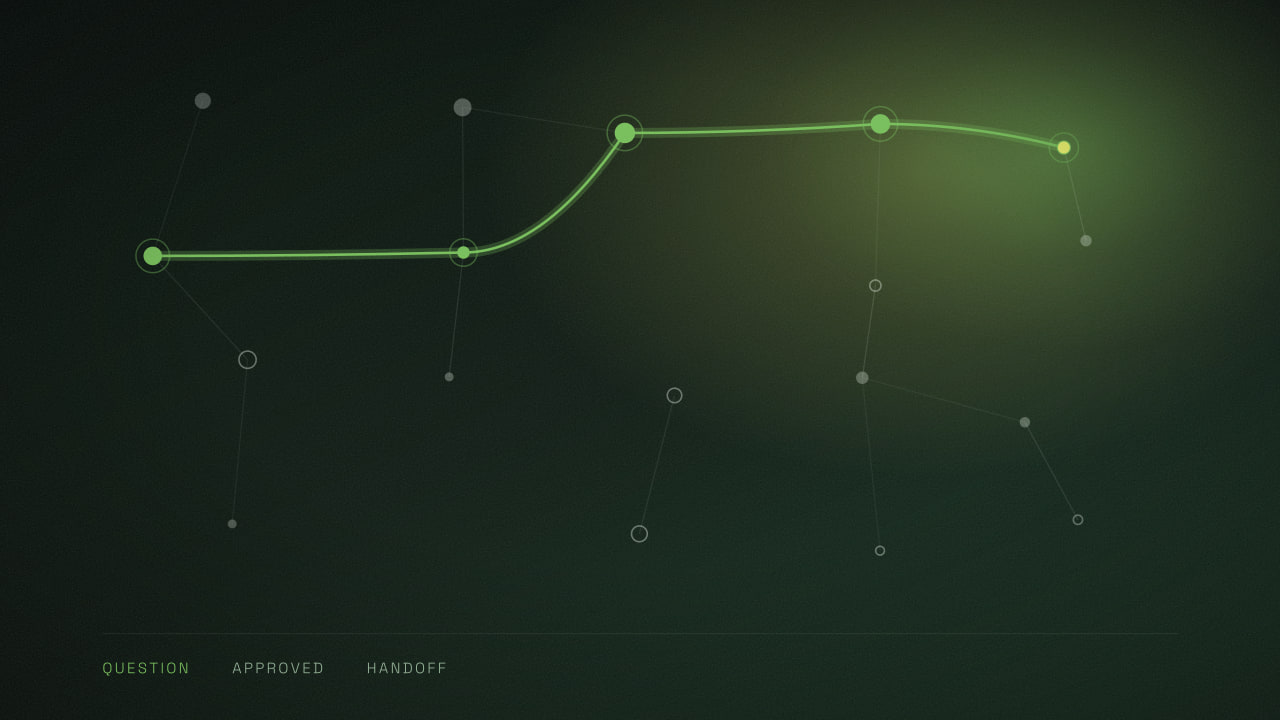
It hands off, and it tells the customer when.
The handoff is the part most deployments get wrong, because it's a scheduling problem wearing an AI costume. Gartner's August 2026 survey of 3,566 customers found that 87 percent say it's essential to have an option to reach a human agent where a company uses generative AI for service, while half said the AI made the interaction easier. Both numbers matter. People will use the agent, and they want the exit visible while they do.
What that looks like in practice:
- A route to a person that is always on screen, not buried behind three failed attempts.
- A structured summary passed over, not a raw transcript. Name, intent, address, what's been promised, what hasn't.
- A real commitment instead of "please wait". At 11:40pm nobody is waiting, so the agent books a slot and says which one.
Say you run a letting agency in Manchester with two people on the phones. Your chat agent should know that a Saturday maintenance report goes to the on-call number and a Saturday viewing request becomes a Monday 9am callback. That's a rota, written down, not a model capability.
Channel changes the mechanics. On WhatsApp the handoff touches your bill: Meta's per-message pricing has applied since July 2025, utility templates delivered inside an open customer service window are free, and outside that window you pay by template category to reopen the conversation. A dental clinic in Dubai Marina taking booking requests at midnight wants to know which replies are free before it designs the follow-up, which is how that pricing lands on a chatbot bill.
Do you have to tell people they're talking to an AI?
In the EU, yes, since 2 August 2026.
Article 50 of the EU AI Act (Regulation (EU) 2024/1689) requires systems that interact directly with people to be built so those people are informed they're dealing with an AI, unless that's obvious to a reasonably well-informed person. BSI puts the date plainly: the Article 50 transparency obligations became applicable on 2 August 2026. A name like Ava and a cheerful greeting is not a disclosure.
Outside the EU there's no single equivalent rule, and the commercial case stands anyway. A customer who works out mid-conversation that they were misled stops being a lead. We went through this for phone calls in whether you have to tell callers it's an AI, and the answer is the same here: say it once, early, in plain words, then be useful.
What changes for chat agents over the next year
Two dated things are worth watching, and one of them is six weeks away.
Article 50(2) covers machine-readable marking: labelling AI-generated content so other systems can detect it. Under the AI Omnibus agreement, systems already on the market get until 2 December 2026 to comply, and the final text is still being settled. If you sell into the EU, that's a question for your chat vendor this month rather than a surprise in December.
The second is that Gartner three-times finding. More customers are asking an assistant you don't control about your business, which quietly promotes your public pages to knowledge base. Publish prices, policies and service areas as plain text on a fast page and assistants read them correctly. Bury them in a PDF and they get guessed at. A heavy chat script can be one of the things slowing that page down, which is its own argument for a light one.
Where a scoped chat agent is the wrong buy
If your pricing lives in your head and changes with the job, we can't build you an agent that quotes, and you shouldn't want one. What you can have is an agent that qualifies, captures the detail a quote needs, and books the visit. That's a smaller promise than the demo where a bot answers everything confidently because nobody checked whether it was right.
Some buyers prefer the confident one. We've lost work to it, and we'd rather say so than pretend the scoped version looks better in a ten-minute demo.
The other cost is yours. Writing the allowed list takes two hours of the owner's time, not the office manager's, because the owner is the one who knows which promises are survivable. Every chat agent we build starts with that session, and when a client can't spare it we push the start date rather than guess at the list ourselves.
The chat agent test to run this week
Open your chat agent in a private window and ask it the three questions you'd least like it to answer. Price match. Same-day availability. A refund outside policy. Then read the transcript as though you were the customer holding the screenshot.
If any answer commits you to something you wouldn't have agreed to, that's your scope document writing itself. Send us the transcript and we'll tell you what we'd lock down, whether or not you build it with us. Get in touch and bring the awkward answers.
Common questions
Still wondering
Can a disclaimer protect us from what our chatbot says?
Not on its own. A general notice in your terms sits a long way from a specific promise made to a specific person who then acted on it. Disclosure that the agent is AI is worth having, and in the EU it is required, but the thing that actually limits your exposure is scope: the agent never states a price, date or refund it has not been given, and routes the rest to a person.
If the vendor's model gets it wrong, is that our problem or theirs?
Almost certainly yours. Most chat platform contracts put responsibility for output on the business deploying the agent, and the customer in front of you has no interest in which model produced the sentence. Read the liability and indemnity clauses before you sign, ask what logging you get, and check whether you can export transcripts. Those three answers tell you how much of the risk sits on your side.
Should a chat agent be allowed to take payments or issue refunds?
Payments, sometimes. Refunds, rarely. Taking a deposit against a published price through a payment link is a narrow action with a fixed amount, which is the kind of thing an agent handles well. A refund is a judgement call about a customer you cannot see, and it is the decision most likely to be exploited by someone testing the bot. Let the agent gather the detail and open the case.
How often should somebody read the chat transcripts?
Weekly for the first month, then monthly. Read every conversation that ended without a booking or a handoff, because that is where the agent answered when it should have collected. You are looking for three patterns: questions it refused that it should answer, answers it gave that it should refuse, and the same question phrased in a way your content does not cover.
Read next

Is your chat widget slowing down your website?
How to tell if a chat widget is slowing down your website, why speed tests miss it, and what a facade costs you in first reply time.
How WhatsApp service message pricing hits your chatbot bill
WhatsApp service message pricing starts billing chat agent replies on 1 October 2026. The free tier is 1,000 messages a month, not 1,000 chats.
What does custom software maintenance cost each year?
Custom software maintenance cost is usually quoted as a percentage of the build. The published end-of-life dates behind your app give a better number.