
Do I have to tell callers it's an AI on the phone?
The disclosure rules that actually apply to an agent answering your line, and the first sentence we'd write for it.
Your agent has been answering the main line for three weeks. It's Thursday, 4:40pm. A caller forty seconds into describing the noise her boiler makes stops mid-sentence.
"Hang on. Am I talking to a person?"
Every owner we build for asks some version of this before go-live, usually about a week out, usually tacked onto the end of a call about something else. Do we have to tell them? Underneath that sits the question they're actually asking: if we tell them, do they hang up?
The legal answer is narrower than the search results suggest, and the practical answer barely depends on it.
#Most AI calling rules govern calls you make, not calls you answer
Search for AI disclosure rules and you'll get a wall of pages about the TCPA, the FCC and California. Read them closely and a pattern shows up. Nearly all of it is about outbound dialling.
In February 2024 the FCC confirmed that the TCPA's restrictions on an "artificial or prerecorded voice" cover today's AI-generated voices. The duties that attach are consent, identification and an opt-out, as Mayer Brown set out at the time. Those are the duties of someone placing a call.
That August the FCC proposed rules on AI-generated calls, and drew the line explicitly. The proposed definition covers outbound calls only, and not AI used to answer inbound calls such as virtual customer service agents.
California's AB 2905 reads the same way. Its own title says what it covers: automatic dialing-announcing devices and artificial voices. Signed on 20 September 2024, in force since 1 January 2025, it requires a caller whose prerecorded message uses an AI-generated or significantly altered voice to say so at the start. It's a robocall rule with a robocall remedy.
So if you've put an agent on the number printed on your van, none of those three is pointed at you. That is not the same as nothing being pointed at you.
#The rules that do reach an agent answering your phone
Maine's is the clearest, and it's the one most people miss. Since 16 September 2025 a business there cannot use an AI chatbot in a way that misleads a reasonable consumer into thinking they've reached a human, unless the consumer is told clearly and conspicuously. The definition reaches textual or aural communications, which puts a phone agent inside it. Verrill's summary notes that a violation is an Unfair Trade Practices Act violation carrying civil penalties up to $1,000 each.
Utah aims at a moment instead of a greeting. Disclosure is required when a consumer clearly asks whether they're dealing with a human or AI, and in high-risk interactions involving sensitive information, with a safe harbour for clear disclosure made upfront. Treat that as a design instruction. If a caller asks the direct question, your agent answers it.
Have callers in Europe? Article 50 of the EU AI Act has applied since 2 August 2026. People must be informed when they're interacting with an AI system, unless that's already obvious, and the information has to be perceivable in the interaction itself rather than buried in your terms. A US company whose line is reachable from the EU is in scope.
Recording is a separate duty that people fold into this one. Twelve states require all-party consent, California, Florida, Illinois, Massachusetts, Pennsylvania and Washington among them. Your agent records, or at least transcribes, because that's how the call reaches your CRM. Two notices, one greeting.
The chatbot bills that made headlines through 2026, California's SB 243 and the New York and Washington equivalents, are aimed at companion bots and minors' safety. Orrick's survey is worth a skim, but don't read those headlines as being about the agent that books your Tuesday service calls. We build these systems and we aren't your lawyers. If you operate across state lines, this is a half-hour conversation worth paying for.
#Say it in the first sentence anyway
Here's what the legal reading misses. Callers don't mind talking to software. They mind finding out.
Gartner's August 2026 consumer survey found 87% of customers say it's essential that companies using generative AI in customer service offer a route to a human agent. Read that as a finding about control rather than about disclosure. People want to know where they are and how to get out.
Then think about what a late discovery does. Your caller has spent four minutes giving an address, a postcode, a boiler model and a preferred morning. At minute five something in the cadence gives it away. Everything she just agreed to turns provisional in her head: was the appointment really booked, did it get the house number right?
So she rings back to check. Your Friday now contains a call that exists only because your greeting was coy. You didn't save a call. You made one.
Disclosure up front changes how the rest of the call goes, too. Callers who know they're talking to software give the postcode in clean chunks instead of a mumble, answer the question you asked rather than the one they expected, and drop the small talk a human receptionist absorbs and an agent has to parse. Shorter calls, fewer retries on the fields that matter.
#How to write the line
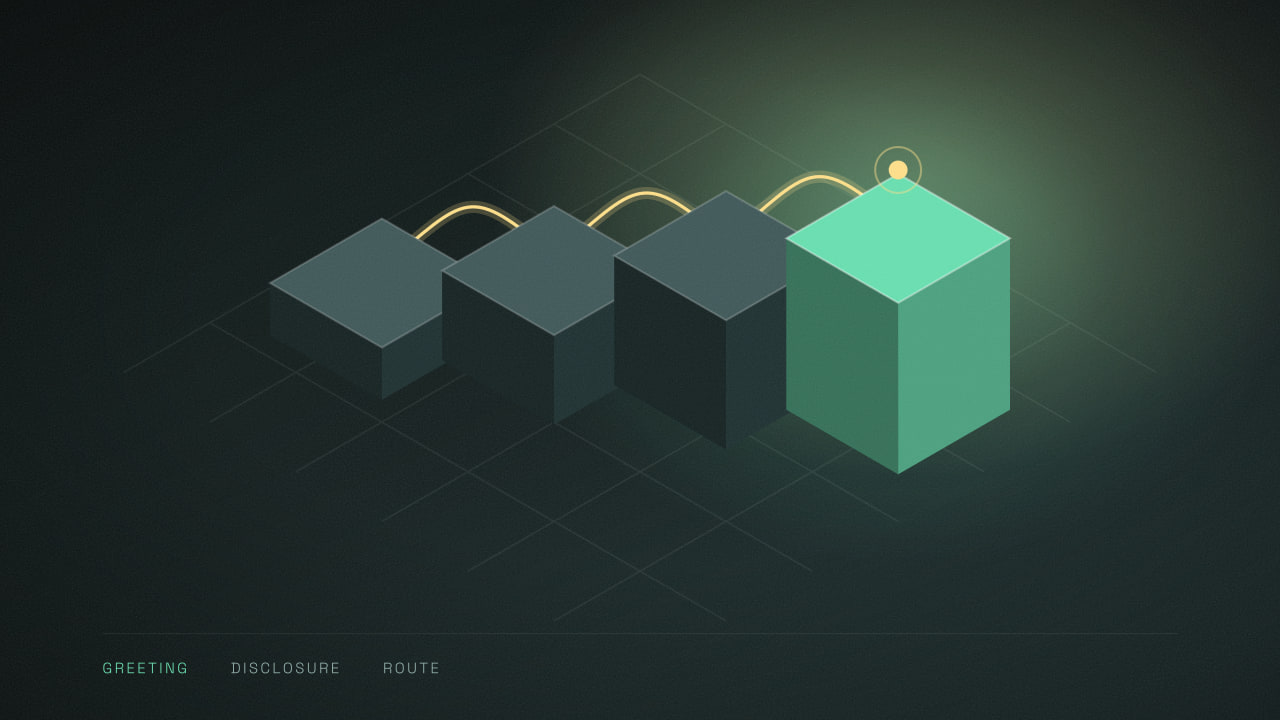
Four parts, in this order: who they've reached, what's answering, what it can do, how to get a person. Six seconds or under.
A version that works, with an invented company name:
"Bayside Heating, this is our automated assistant. I can book a visit or get someone to call you back. Which is easier?"
A version that doesn't:
"Hi there! I'm an AI-powered virtual assistant using advanced conversational technology to help with your enquiry today."
Nobody rang to hear about your stack. The second one also buries the label mid-sentence, where a caller half-listening for a human voice misses it.
Specifics we've settled on after building a lot of these:
Say "automated" before you say "AI". AI is a product category. Automated is a fact about who's talking, and if Maine's clear and conspicuous standard is on your mind, the plainer word is the safer one.
Don't give it a human first name. "This is Emma" invites exactly the belief you just disclaimed. It's also the detail that makes people feel tricked when the penny drops.
Put the label before your first question. Ask "how can I help?" first and the caller is already talking, already committed, already describing the noise the boiler makes.
Fold the recording notice into the same breath. It belongs before anything sensitive gets said, not appended after a card number.
Answer the direct question straight. When someone asks "is this a real person?", the answer is no, then the offer: "I'm automated. Want me to get someone to call you back?" No deflection, no "I'm here to help you today". A caller who has to ask twice is a caller you've lost.
We also keep a flag on every transcript for whether the caller asked. It rides the same pipeline that writes the call into your CRM, and it costs nothing to add. If that rate climbs, your greeting has stopped landing, and the fix is reading ten transcripts before touching anything else.
#What this costs, and who shouldn't do it
Some callers hang up when they hear "automated assistant". I won't hand you a percentage, because it moves with the vertical, the hour and how urgent the caller's problem is. Any single figure would be one I made up.
Measure your own instead. Hang-ups inside the first ten seconds, weekly, against what the line did before.
That last comparison is where people go wrong. Your agent isn't competing with a receptionist who picks up on the second ring. On the calls it actually handles, the 7:40pm ones and the ones where both vans are out, it's competing with a voicemail beep nobody leaves a message on. Against that, an agent that discloses and loses a few callers still wins. Against a human answering in two rings, it loses every time.
The harder concession: for some businesses we tell people not to buy this. A funeral home, a mental health practice, a dentist taking a 2am call from someone in real pain. If the caller's first sentence is likely to be distressing, an agent answering first is the wrong build, and the disclosure doesn't rescue it. Being told you've reached an automated assistant while you're frightened is its own small insult.
Route those lines to a person, or to a callback inside five minutes, and put the agent on overflow and after-hours instead. We've talked ourselves out of work this way.
A disclosure won't save a weak agent either. If it can't take a postcode, can't say "I don't know, let me get someone", or can't tell an emergency from a quote request, announcing that it's automated just tells the caller who to blame. Settle what a voice agent can and can't do on a call before you go near the greeting.
#Do this today
Write your greeting as one sentence. Read it out loud with a stopwatch, and if it runs past six seconds, cut words until it doesn't. Make sure "automated" survives the cut.
Then ring your own main line and listen as a customer would, at 5pm, from a car, with the radio on. You'll hear the problem in three seconds.
If you'd rather someone else wrote that line and wired the routing behind it, tell us what happens on your phone now and we'll tell you what we'd change.
Common questions
Still wondering
Is it legal to use an AI receptionist without telling callers?
Federally in the US there is no blanket inbound disclosure rule, and the FCC's proposed definition of an AI-generated call covers outbound calls only. State law is where the exposure sits. Maine bars misleading a consumer into thinking they reached a human, Utah requires an answer when someone asks directly, and the EU AI Act requires disclosure for callers in Europe. Ask a lawyer about your states.
Does California's AB 2905 apply to an AI answering service?
Its own title describes what it covers, automatic dialing-announcing devices and artificial voices, which is outbound robocalling. It took effect on 1 January 2025 and requires a caller using an AI-generated or significantly altered voice in a prerecorded message to disclose that at the start. An agent that picks up your inbound line is a different thing, though California recording consent rules still apply to it.
What should an AI phone agent say when it answers?
Four parts in six seconds or less: the business name, the word automated, what the agent can actually do, and the route to a person. Something like this. Bayside Heating, this is our automated assistant, I can book a visit or get someone to call you back. Put the label before your first question, and fold any recording notice into the same breath.
Do callers hang up when they hear it is an AI?
Some do, and the rate moves with the vertical, the hour and how urgent the problem is, so treat any single published figure with suspicion. Measure hang-ups inside your own first ten seconds, weekly. Compare them against what the line did before, which on after-hours and overflow calls was usually a voicemail nobody left a message on, rather than against a human answering fast.
Should the agent have a human name like Emma?
No. A human first name invites the belief you disclaimed one sentence earlier, and it is the detail that makes people feel tricked when they work it out several minutes into a call. Name the business, call the thing an automated assistant, and spend the personality budget on handling interruptions and taking a postcode accurately instead.
Read next
Can I keep my phone number with an AI receptionist?
You can keep the number on the van. Forwarding moves the calls, not the number, and here are the four things it quietly leaves behind.
What an AI receptionist can and cannot do on a call
An honest look at what an AI receptionist handles well on a live call, what it should never be given, and how to set the escalation boundary.
How to tell if an AI receptionist CRM integration is real
Most AI phone vendors say they integrate with your CRM. Here is what that word hides, and the one live test that tells you which level you are buying.