
AI voice agents
AI voice agents that answer every call
We build AI voice agents that pick up on the first ring, day or night, qualify the caller against your criteria, book the job into your calendar and write the call to your CRM. When a person is genuinely needed, the call goes to one, with the context attached.
What is an AI voice agent?
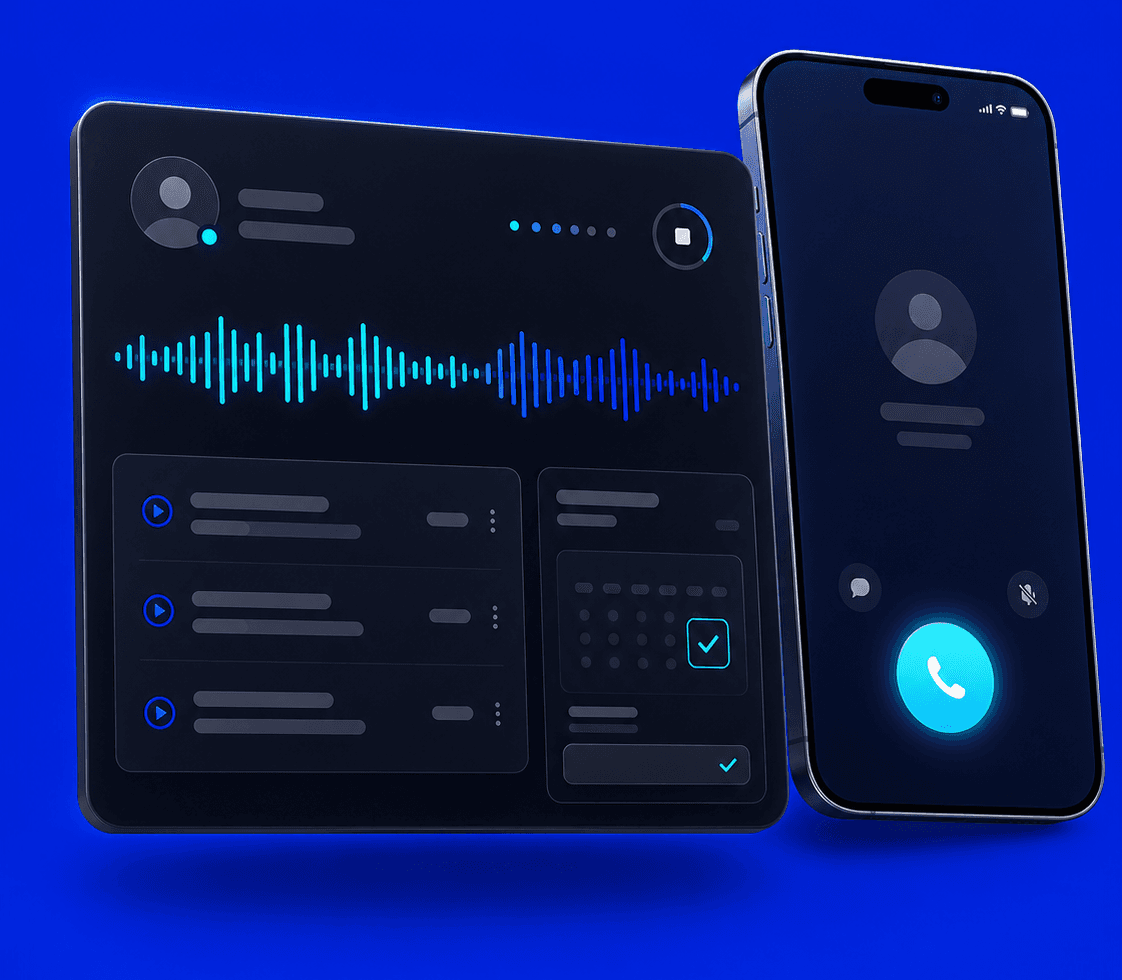
An AI voice agent is software that answers a phone call and talks with the caller in natural speech. It listens, works out what the caller wants, asks the questions a good receptionist would ask, and then acts: it books an appointment, answers a question from your own information, takes a message or transfers the call.
People search for the same thing under different names: AI receptionist, AI phone agent, AI call answering, virtual receptionist. The label matters less than one question. Is the agent wired into your calendar and CRM, so the call ends with something done rather than a voicemail somebody has to chase?
What our voice agents handle on a call
Every agent is built around your front-office script, not a generic one. A typical build covers:
- Inbound calls, answered on the first ring, 24 hours a day, every day of the year
- Outbound calls for follow-ups, reminders and responses to campaign enquiries
- Qualification against your own criteria: job type, location, budget, urgency, whatever decides whether a lead is worth a visit
- Live calendar booking, so the caller leaves with a confirmed time
- Answers to routine questions from your services, prices and policies
- Warm transfer to your team when the conversation needs a person
- A log of every call in your CRM, with the transcript and the outcome
When does the agent hand off to a person?
The escalation rule matters more than the script. Before we write a line of code, we agree with you exactly when the agent stops: an emergency, an upset caller, a question outside what it knows, a request for a named person. For each one you decide what happens. Transfer the call, take a message, or book a callback.
Either way the full transcript lands in your CRM, so whoever picks it up doesn't ask the caller to start again. That boundary is what makes a voice agent safe to put in front of patients, clients and customers. We've written more about what an AI receptionist can and cannot do on a call.
Will callers know they're talking to an AI?
What gives a voice agent away is rarely its vocabulary. It's the pause before it answers and the way it copes with being interrupted. Our agents respond in under a second and handle natural interruptions, and we tune each one against your real call recordings before it takes a live call.
A caller paying close attention may still notice. That's fine, and it's why the handoff exists. What most callers care about is that the phone was answered and their problem got dealt with.
How we build a voice agent
- Audit. We map every way calls reach you today and find where they leak: after hours, lunchtime, the second line that rings out.
- Design. Conversation flows, qualifying questions, escalation rules and the data the agent writes, agreed in writing before anything is built.
- Build and integrate. The agent is wired into your phone number, calendar and CRM, then tested against your real call recordings.
- Tune. We review transcripts and outcomes every week after launch. The system gets sharper every month it runs.
Works with the phone number, calendar and CRM you already have
You don't have to change your phone system or your CRM. We integrate with what you have: Google Calendar and Outlook for bookings, HubSpot, Salesforce and Zoho for records, Gmail and Outlook for notifications. If your current setup is genuinely holding you back we'll say so, but that's a recommendation, not a requirement.
Because we also build workflow automation and CRMs, the call doesn't stop at the booking. Confirmations, reminders and reporting can run off the same record.
Hear one before you decide
Three demo agents run in the browser on our homepage, each built around a real front-office job. Tom qualifies buyers and tenants for a property team and books viewings. Aria handles inbound campaign interest and routes qualified opportunities. Anna is a patient receptionist for a private clinic: she answers routine questions, finds appointment times and passes urgent requests to staff. Try them on the homepage.
What does an AI voice agent cost?
It depends on call volume, the number of systems involved and how much of the conversation the agent owns. We don't publish a rate card, because two builds are rarely the same. After a thirty minute call you get scope, timeline and price in writing. No pitch deck.
Common questions
Questions about AI voice agents
How long does it take to go live?
Most deployments go live in three to six weeks, depending on how many systems we're integrating. The design step, where conversation flows and escalation rules are agreed, is the part not to rush.
Do we have to change our phone system or CRM?
No. We integrate with what you have. If your setup is genuinely holding you back we'll say so, but that's a recommendation, not a requirement.
Can the agent make outbound calls?
Yes. Voice agents handle inbound and outbound calling, including follow-ups, reminders and responses to campaign enquiries.
What languages do your voice agents speak?
Our voice agents are live in six languages, and you choose the voice your callers hear.
How is call data handled?
Encrypted in transit and at rest, with region-specific hosting and compliance support where your industry requires it.
What if the agent gets something wrong?
The design step limits what it's allowed to do, testing against your real recordings catches problems before launch, and the weekly review catches anything after. Every call is logged, so a mistake is visible and fixable rather than hidden.